1487: "The Laurel Run Mine Fire"
Interesting Things with JC #1487: "The Laurel Run Mine Fire" – A forgotten lamp. A weekend without crews. And a coal seam that kept burning long after the miners left. A century later, the heat still rises through the ridge.
Curriculum - Episode Anchor
Episode Title: The Laurel Run Mine Fire: A Century Underground
Episode Number: 1487
Host: JC
Audience: Grades 9–12, college intro, homeschool, lifelong learners
Subject Area: Earth science, U.S. industrial history, mining engineering, environmental science
Learning Objectives
Students will be able to:
• Define what an underground coal mine fire is and identify its key characteristics.
• Compare early 20th-century firefighting and surveying methods to later technological approaches.
• Analyze how the geology of the anthracite field influenced the spread of the Laurel Run Mine Fire.
• Explain the long-term environmental and community impacts of persistent subsurface coal fires.
Key Vocabulary
• Anthracite (AN-thruh-sight) — A hard, high-carbon coal; Anthracite’s slow-burning properties contributed to the long duration of the Laurel Run fire.
• Carbide lamp (CAR-bide lamp) — A miner’s lamp that produces light from a chemical reaction; A carbide lamp left burning ignited the timber.
• Borehole (BORE-hole) — A drilled shaft into the earth used for monitoring or extracting materials; Engineers used boreholes to track temperature and gas readings.
• Bulkhead (BULK-head) — A barrier or wall used to seal mine passages; Crews added bulkheads in the 1960s to slow the fire’s progression.
• Vein (vayn) — A mineral or coal seam within surrounding rock; The fire spread into multiple anthracite veins in the Red Ash and Stanton workings.
Narrative Core
Open: A miner ends his shift in December 1915, leaving a carbide lamp burning on a timber—an action that unknowingly starts a century-long coal fire beneath Laurel Run, Pennsylvania.
Info: Attempts to control the fire failed as it moved along dipping coal beds into deeper workings. Engineers in the 1920s conducted early systematic surface surveys using boreholes to map its spread.
Details: Temperatures in the abandoned chambers reached approximately 1,000°F. By the 1930s, residents noticed sulfur odors. In the 1960s, state and federal crews intervened, cutting trenches, building bulkheads, and eventually buying out homes above unstable ground.
Reflection: Despite extensive engineering efforts, the mine fire persists in isolated pockets—an enduring reminder of how small human actions, combined with geology, can produce long-term environmental consequences.
Closing: These are interesting things, with JC.
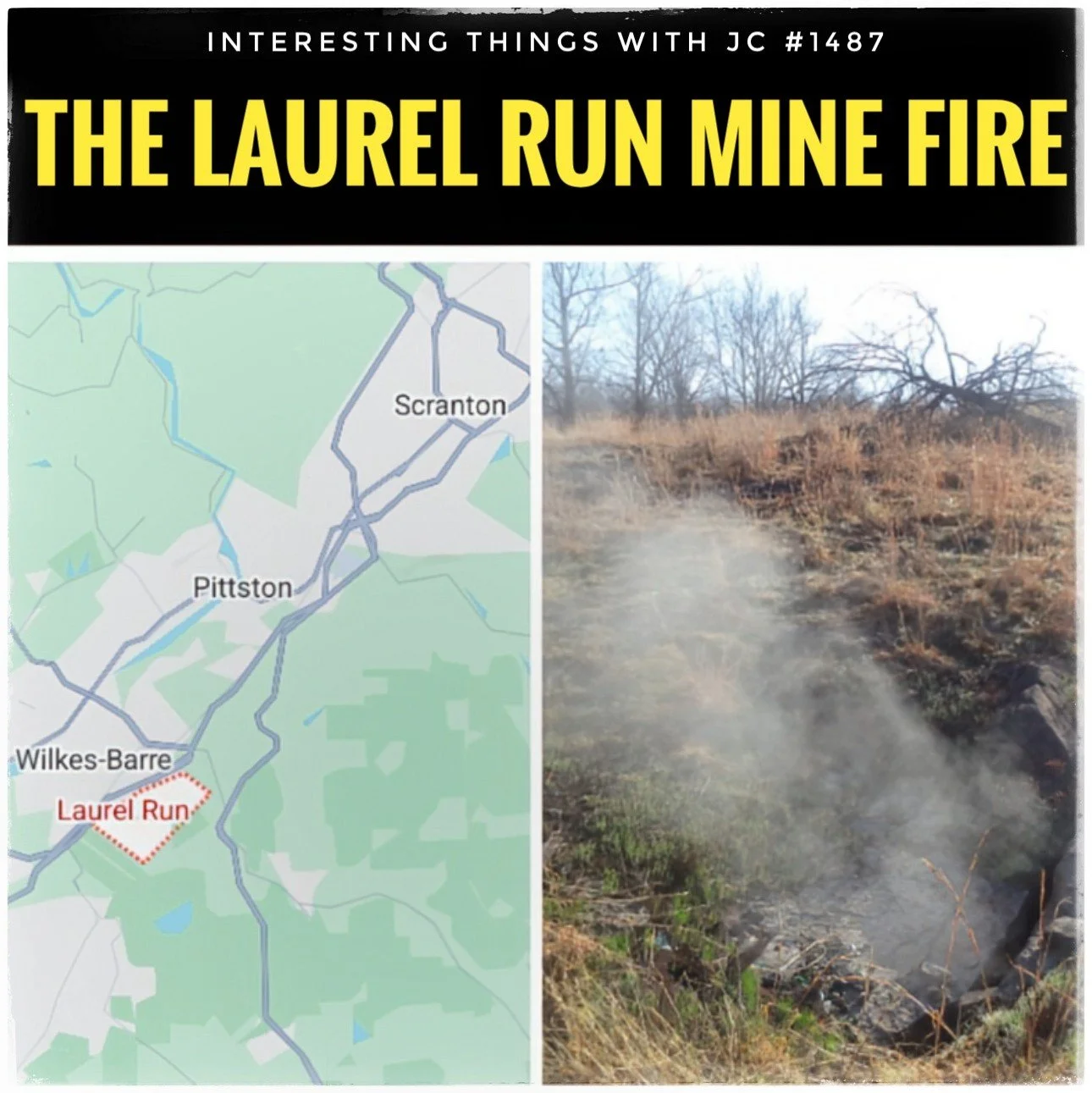
A split graphic promoting “Interesting Things with JC #1487: The Laurel Run Mine Fire.” The left side shows a simplified map of northeastern Pennsylvania with Scranton, Pittston, Wilkes-Barre, and the borough of Laurel Run marked in red. The right side shows an outdoor scene on a grassy hillside with bare trees in the background and visible white steam rising from a mine fire vent in the ground.
Transcript
In December of 1915, a miner at the Red Ash Coal Mine near Laurel Run (LAW-rel Run), Pennsylvania, ended his shift and left a carbide lamp burning on a timber. It was December 6. Over the weekend, with no crews underground, the lamp ignited the timber and then the anthracite (AN-thruh-sight) seam behind it. When miners returned on Monday, the fire had already taken hold inside the workings.
The operators tried to contain it with the methods available at the time. They pushed sand into openings and built concrete seals. Early notices said the fire had been stopped. It hadn’t. The coal beds in that section tilt about 10 to 15 degrees, and the fire followed old rooms and crosscuts into deeper parts of the mine. By the early 1920s, engineers confirmed it had spread into multiple veins tied to the Red Ash and Stanton workings.
During that same decade, Pennsylvania engineers drilled a series of shallow and deep boreholes across the ridge to track the fire using temperature and gas readings. This became one of the earliest systematic surface-based surveys of an underground coal fire in the northern anthracite field. The results showed a larger, more connected burn zone than operators expected.
Inside those old chambers, temperatures reached about 1,000 degrees Fahrenheit (540 degrees Celsius). The fire sat roughly 200 to 300 feet underground (60 to 90 meters). Heat fractured the rock, and vents opened near homes along the ridge. Residents reported sulfur odors on cold mornings as early as the 1930s.
By the 1960s, state and federal crews stepped in with heavier work. They cut trenches, added new bulkheads, and bought out families living above the most active area so equipment could move safely. The fire slowed, but not enough to extinguish it. Surveys from the late 20th and early 21st century show it still active in isolated chambers.
The Laurel Run fire remains one of the longest-burning in the northern anthracite field, a reminder of how one event in a mine can continue long after the mining ends.
These are interesting things, with JC.
Student Worksheet
What event triggered the Laurel Run Mine Fire in December 1915?
How did the geology of the coal beds contribute to the fire’s spread?
Why were boreholes important to engineers studying the fire in the 1920s?
Describe one major action taken in the 1960s to slow the fire.
Creative Prompt: Design a small diagram or written model explaining how a mine fire can create surface vents near homes.
Teacher Guide
Estimated Time
45–60 minutes
Pre-Teaching Vocabulary Strategy
Use a Frayer Model for anthracite, borehole, and bulkhead. Provide images of carbide lamps and coal seam diagrams.
Anticipated Misconceptions
• Students may assume all coal fires burn quickly; in fact, anthracite fires can burn for decades or centuries.
• Students may think modern technology can extinguish any subsurface fire; this is not always feasible.
Discussion Prompts
• What does the Laurel Run Fire reveal about early industrial safety practices?
• How does subsurface geology influence human attempts to control natural or industrial hazards?
• Should long-burning coal fires always be extinguished, or can some be safely contained?
Differentiation Strategies
• ESL: Provide vocabulary with images and sentence frames.
• IEP: Chunk the transcript and offer guided notes.
• Gifted: Extend research to compare Laurel Run with Centralia, Pennsylvania, or global coal fires.
Extension Activities
• Conduct a heat-transfer lab modeling how fires spread through varying materials.
• Map historical mining operations in the northern anthracite field.
Cross-Curricular Connections
• Physics: Heat transfer, conduction through rock layers.
• Sociology: Community relocation and displacement.
• Ethics: Responsibility of mine operators and regulators.
Quiz
Q1. What caused the initial ignition of the Laurel Run Mine Fire?
A. A lightning strike
B. A carbide lamp left burning
C. A gas explosion
D. Hot machinery
Answer: B
Q2. How deep was the fire located beneath the surface?
A. 20–30 feet
B. 50–80 feet
C. 200–300 feet
D. 500–700 feet
Answer: C
Q3. What method did engineers use in the 1920s to track the fire?
A. Thermal drones
B. Seismic imaging
C. Satellite sensors
D. Borehole temperature and gas readings
Answer: D
Q4. Which decade saw major state and federal intervention?
A. 1910s
B. 1920s
C. 1930s
D. 1960s
Answer: D
Q5. What geological feature helped the fire spread?
A. Horizontal shale layers
B. Water-filled chambers
C. Coal beds dipping 10–15 degrees
D. Volcanic vents
Answer: C
Assessment
Explain why underground coal fires like Laurel Run can continue burning for over a century.
Analyze how early containment efforts differed from those carried out in the 1960s.
3–2–1 Rubric
3 = Accurate, complete, thoughtful; uses evidence from the episode.
2 = Partially accurate; missing detail or clarity.
1 = Inaccurate, vague, or unsupported.
Standards Alignment
NGSS (Science)
• HS-ESS2-1 — Students analyze geologic processes influencing natural phenomena, such as subsurface fire spread.
• HS-ESS3-1 — Evaluates human impacts on Earth systems, including mining and long-term fires.
• HS-ETS1-2 — Supports evaluating engineering attempts (bulkheads, trenches, boreholes).
Common Core ELA
• CCSS.ELA-LITERACY.RI.11-12.1 — Cite textual evidence from the transcript to support analysis.
• CCSS.ELA-LITERACY.RST.11-12.3 — Follow technical descriptions of historical mining interventions.
• CCSS.ELA-LITERACY.WHST.9-12.2 — Write explanatory texts about geologic and engineering processes.
C3 Social Studies Framework
• D2.His.14.9-12 — Analyze multiple factors influencing historical events, such as industrial hazards.
• D2.Geo.4.9-12 — Evaluate how environmental processes affect human settlements.
ISTE Standards
• ISTE 3.3 — Students evaluate data (temperature readings, borehole findings) for decision-making.
• ISTE 4.6 — Apply computational and design thinking to model subsurface fire behavior.
International Equivalents
UK National Curriculum (Geography, Key Stage 4)
• Physical processes — Understanding geological processes like heat transfer in rock strata.
Cambridge IGCSE Geography
• 2.1 Earth Processes — Role of natural processes and human activity in environmental hazards.
IB MYP Sciences (Level 4–5)
• Criterion A: Knowing and Understanding — Demonstrates knowledge of environmental systems such as coal fires.
Show Notes
The Laurel Run Mine Fire began in 1915 when a carbide lamp accidentally ignited a timber and adjacent anthracite seam inside the Red Ash Coal Mine. Despite early attempts at sealing and sand-filling, the fire migrated along dipping coal beds into deeper interconnected workings. Through the 1920s, engineers mapped the spreading fire using boreholes, an early example of surface-based subsurface monitoring. By mid-century, fumes and fractures appeared near residential areas, prompting state and federal intervention, trenching, bulkhead construction, and eventual property buyouts. The fire persists today in isolated chambers, offering classrooms a valuable case study in geoscience, engineering limitations, industrial history, and long-term environmental impact.
References
Pennsylvania Department of Environmental Protection. (2024). Laurel Run Mine Fire. Commonwealth of Pennsylvania. https://files.dep.state.pa.us/mining/Abandoned%20Mine%20Reclamation/AbandonedMinePortalFiles/Centralia/PAFireLocationTable.pdf
U.S. Geological Survey. Coal fires & environmental impacts. U.S. Department of the Interior. https://pubs.usgs.gov/publication/fs20093084
U.S. Office of Surface Mining Reclamation and Enforcement. Abandoned Mine Land program overview. U.S. Department of the Interior. https://www.doi.gov/ocl/abandoned-mine-land
Pennsylvania Department of Environmental Protection. (2015, May 12). Laurel Run, Pennsylvania: Fire beneath the mountain. https://www.abandonedcountry.com/2015/05/12/laurel-run-pennsylvania-fire-on-the-mountain/
Spector, D. (2012, May 30). There’s Another Pennsylvania Ghost Town That’s Been Burning For 97 Years. Business Insider. https://www.businessinsider.com/laurel-run-borough-mine-fire-2012-5
Nolter, M. A., Vice, D. H., & Aurand, H. (2007). Comparison of Pennsylvania anthracite mine fires: Centralia and Laurel Run. GSA Reviews in Engineering Geology, 18, 261-270. https://pure.psu.edu/en/publications/comparison-of-pennsylvania-anthracite-mine-fires-centralia-and-la/